Workshop A
What Meaningful Human Rights Due Diligence Approaches Look Like in Practice
10 Sep (Thur) Day 1 : 10:15 – 11:30
As human rights due diligence (HRDD) becomes increasingly embedded in regulation, investor expectations and business practice, companies are investing significant time and resources in monitoring, auditing, reporting and managing human rights risks across their supply chains.
But are we using social audits and sustainability reporting in the right way?
These mechanisms can provide valuable visibility into human rights risks. Yet monitoring alone does not prevent harm. When resources are concentrated on identifying and reporting problems, with less attention given to addressing root causes and funding meaningful remediation, companies risk becoming better at documenting problems without becoming better at solving the root cause.
This interactive workshop will examine what it takes to turn social audits and sustainability reporting into more effective levers for change. Drawing on practical insights from business and implementation perspectives, and The Centre for Child Rights and Business’s latest proprietary research studies, we will explore how companies can use these mechanisms more strategically, influencing internal decision-making and investment, and strengthening their approaches to prevention and remediation, particularly in relation to child labour.
Rather than presenting another set of best-practice checklists, the session will ask a more fundamental question: How can we make the audits and reports companies already use work harder for people at risk of harm?
Through facilitated peer discussions and group exercises, participants will actively co-create actionable recommendations alongside fellow practitioners. The goal is for everyone to leave not just with ideas, but with practical recommendations, developed by peers in the room, that can be taken back into their own organisations and applied to strengthen HRDD in practice
Session Learnings:
By the end of this session, participants will be able to:
- Shift from compliance to strategy: Move beyond using social audits as mere compliance checklists and understand how to integrate the human rights data they generate into core corporate strategy and governance.
- Apply auditor insights to real-world challenges: Examine key findings from The Centre for Child Rights and Business’s latest global study on social auditors’ experiences, with specific attention to how child labour and forced labour are identified and the barriers to effective remediation.
- Strengthen HRDD through child rights disclosures: Drawing on Making Children Count: Sustainability Reporting—the latest UNICEF report authored by The Centre—participants will explore how robust child rights disclosures build stakeholder trust, enhance due diligence performance, and meet evolving regulatory expectations.
- Build internal buy-in for resource allocation: Start developing practical business-case arguments to secure the necessary resources and internal stakeholder commitment for strengthening HRDD across supply chains.
Post-Event Actions:
The Centre will produce a resource capturing guest speaker insights and the consolidated recommendations from workshop group activities. The resource will identify common challenges, promising practices, and actionable strategies to strengthen HRDD—to be shared with all participants post-event.
Speakers

Gayang Ho
Director of Research
The Centre for Child Rights and Business

Gayang Ho
The Centre for Child Rights and Business
Director of Research
Gayang leads the research team in developing research studies, impact assessment tools, and insights based on evidence at The Centre for Child Rights and Business. Her work focuses on child and human rights due diligence issues and related risk areas. She has more than 18 years of experience in market and policy research across various private, public, and social sectors.
Before joining The Centre, she worked on research programmes related to sustainable development, such as climate change, sustainable mobility, sustainable development education, corporates’ sustainability programmes, and environmental philanthropy. She has published and presented her work at or on behalf of various development bodies, including UNDP, Asia Development Bank, UNICEF. Her exposure to different sectors, stakeholders, and international markets helps The Centre spread awareness of child rights risks and solutions among the business community. She has a Master of Commerce from the University of New South Wales and a Bachelor of Business Administration from the University of Toronto.
Speaking at 2026 sessions:
Day 1
What Meaningful Human Rights Due Diligence Approaches Look Like in Practice
Ines Kaempfer
CEO
The Centre for Child Rights and Business
Ines Kaempfer
The Centre for Child Rights and Business
CEO
Ines is the CEO of The Centre for Child Rights and Business, a global social enterprise headquartered in Hong Kong, with programmes and staff across over 30 countries. With over 15 years of expertise in supply chain sustainability, she has been at the forefront of addressing child rights, labour rights, and human rights issues in Asia and beyond.
Since 2014, Ines has been instrumental in guiding The Centre to help businesses understand and address their impact on children, especially within supply chains. She leads the organisation’s strategic direction, overseeing global operations, and engaging with major multinational companies and partners. Ines also drives the development and scaling of innovative child rights and human rights due diligence programmes across diverse industries.
Under her leadership, The Centre has grown into a recognised leader in child rights and business, working with an expanding network of international companies and partners to create lasting, positive change for children, youth and parents worldwide.
In addition to her role at The Centre, Ines serves as the Chair of the Steering Committee of the Fair Cobalt Alliance (FCA), a multi-stakeholder platform launched in 2020 to mobilise supply chain-wide resources and support a fair, safe and formal artisanal cobalt sector. As Chair, she helps guide the FCA’s strategic direction, align stakeholders and ensure accountability to its mission. She also serves on the Advisory Board of the Association of Professional Social Compliance Auditors (APSCA), where she contributes to developing recommendations that support APSCA’s mission and objectives and represent the perspectives of all stakeholders.
Speaking at 2026 sessions:
Day 1
What Meaningful Human Rights Due Diligence Approaches Look Like in Practice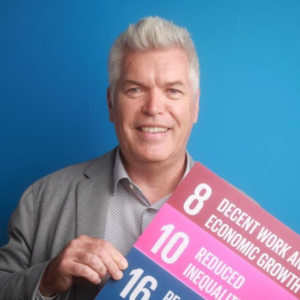
Geoff Trotter
Senior Sustainability Advisor
The ESG Institute
Geoff Trotter
The ESG Institute
Senior Sustainability Advisor
Geoff Trotter has built a 40+ year career in London, Hong Kong and San Francisco, during which time he held a series of CxO roles in the ‘for-profit’ and ‘not-for-profit’ sectors, and as a Big 4 Partner in Hong Kong centred around Information Services, Knowledge Management, Sustainability and ESG Measurement & Reporting.
Geoff is a Senior Sustainability Advisor with The ESG Institute. He is also a Founder Member of The Coaching Circle by Dr. John Blakey, an Executive Coaching organisation that places Trust, Purpose and Values at the centre of organisational leadership.
Speaking at 2026 sessions:
Day 1
What Meaningful Human Rights Due Diligence Approaches Look Like in Practice
Satte Tsao
Head of Vendor Compliance
Li & Fung Trading Ltd.

Satte Tsao
Li & Fung Trading Ltd.
Head of Vendor Compliance
Satte Tsao is Head of Vendor Compliance at Li & Fung, where she leads global initiatives in due diligence, responsible sourcing, supplier compliance, and ESG across global supply chains. She works closely with suppliers, customers, and industry partners to strengthen labor standards, responsible recruitment, worker wellbeing, and supply chain transparency. With extensive experience in supply chain governance and social sustainability, her focus is on implementing practical, risk-based due diligence approaches that help identify, prevent, and address social and ethical risks while delivering meaningful outcomes for workers, businesses, and communities.
My Sustainability Goals for 2026:
There is growing recognition that due diligence and social sustainability are strategic business priorities rather than solely compliance obligations. Organizations are increasingly focusing on proactive risk management, supply chain transparency, and meaningful outcomes for workers and businesses.
Speaking at 2026 sessions:
Day 1
What Meaningful Human Rights Due Diligence Approaches Look Like in PracticeWith thanks to
The Centre for Child Rights and Business
Booth SE-06
The Centre helps companies navigate child rights, ESG and human rights due diligence (HRDD), supporting compliance with evolving international frameworks, reporting requirements and legislation. Through our work, businesses strengthen responsible supply chain management while contributing to meaningful, lasting improvements for children, youth and families.
Our mission is to help companies understand and enhance their direct and indirect impact on children, and to embed child rights into core business practices and sustainability strategies to drive long-term change.
Headquartered in Hong Kong, we work with companies locally and globally across more than 30 countries. We support businesses operating in Hong Kong and throughout Asia, Africa, Europe and the Americas in addressing child rights and human rights risks within their operations, supply chains and wider business relationships, helping them meet growing stakeholder expectations and sustainability commitments.
Solutions Showcase:
- ESG Reporting/Consultancy
- Social Enterprise
- Sourcing & Supply Chain
- Strategic/Corporate Consultancy
- Sustainability Services
Legal Name: CCR CSR (HK) Limited
General Enquiry Email Address: info@childrights-business.org
General Business Address: Unit 808, 8/F, Tung Che Commercial Centre, 246 Des Voeux Road West, Sai Ying Pun, Hong Kong